
SEO, AEO & GEO: How We Optimized One Article for Google, AI Overviews, and Generative Search
Search engines used to rank pages. Today they retrieve answers. Tomorrow they'll recommend trusted sources. Here's how we optimized one article for all three.
SEO
Gagan Gujral
7/14/20264 min read
The Biggest Shift in Search Since Google Was Born
Term Definition
SEO The practice of optimizing content so search engines can find, understand, and rank it.
AEO The practice of structuring content so answer engines (AI Overviews, Featured Snippets, voice search) can extract a direct answer from it.
GEO The practice of building authority and originality so generative AI models choose to cite your content as a trusted source.
For nearly three decades, digital marketers have measured success using one question:
"Where do we rank?"
It was a logical metric.
If your website appeared at the top of Google's search results, people clicked. Those clicks became visitors. Visitors became leads. Leads became customers.
Everything in search engine optimization revolved around improving that single outcome.
Then something changed.
Google introduced AI Overviews.
ChatGPT became a search tool.
Perplexity began answering questions with cited sources instead of blue links.
Gemini started summarizing entire topics before users ever visited a website.
For the first time in the history of search, people could receive complete answers without opening a single webpage.
That seemingly small change fundamentally altered how content is discovered.
The objective is no longer just earning a click.
The objective is becoming the source an AI system chooses to trust.
That distinction is creating confusion across the marketing industry.
Businesses hear new terms every week.
Answer Engine Optimization (AEO).
Generative Engine Optimization (GEO).
AI SEO.
LLM Optimization.
Some dismiss them as marketing buzzwords.
Others believe traditional SEO is dead.
Neither conclusion is correct.
What has actually happened is much more interesting.
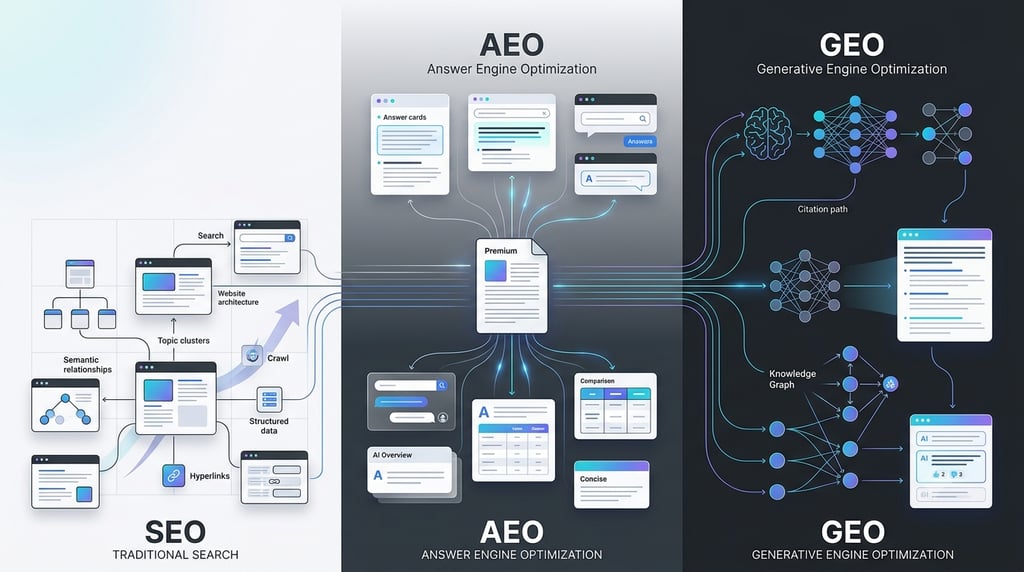
Search has evolved into three distinct discovery systems.
Traditional search still determines which pages deserve visibility.
Answer engines decide which passages deserve extraction.
Generative AI decides which sources deserve citation.
Those are different jobs.
They require different optimization techniques.
Yet most businesses continue publishing content as though only Google's crawler matters.
As of March 2026, AI Overviews now appear on more than 48% of all Google searches — up from just 6.49% the year before.
Why Another "SEO vs AEO vs GEO" Article Would Be a Mistake
Before writing this article, we reviewed dozens of pages ranking for terms like:
SEO vs AEO
GEO optimization
Answer Engine Optimization
AI SEO
SEO for ChatGPT
Almost every article followed the same structure.
First came three definitions.
Then a comparison table.
Then a short conclusion explaining that all three are important.
Technically, there was nothing wrong with those articles.
The problem was that they all sounded almost identical.
One article referenced another.
That article referenced someone else.
Eventually, every definition traced back to the same handful of industry publications.
The result was an internet full of accurate—but interchangeable—content.
From Google's perspective, that may still be acceptable.
From an AI model's perspective, it creates a different challenge.
If twenty websites all repeat the same explanation using slightly different words, why should an AI system reference the twentieth one instead of the first?
Originality becomes increasingly valuable in a world where machines synthesize information.
That's the realization that changed how we approached this project.
Instead of publishing another explanation of SEO, AEO, and GEO, we decided to document something that didn't already exist. we decided to document something that didn't already exist. You can find more breakdowns like this on our blog.
We optimized a live article using all three frameworks simultaneously and recorded every decision we made along the way.
This article is the result.
Rather than telling you what these optimization methods are, we'll show you how they work in practice.
Understanding the Three Discovery Engines
Although they're often discussed together, SEO, AEO, and GEO solve different problems.
Think of them as three layers built on the same foundation.
Layer One: Search Engine Optimization (SEO)
SEO is still the foundation.
Its job is to help search engines discover, understand, and rank your content.
That involves familiar disciplines covered under our SEO services:
Technical SEO
Site architecture
Crawlability
Internal linking
Page speed
Search intent alignment
Content quality
Structured headings
Semantic relevance
Without these fundamentals, your content struggles to become visible in the first place.
SEO answers one question:
"Should this page appear in search results?"
Layer Two: Answer Engine Optimization (AEO)
Once your content is indexed, another competition begins.
Google now extracts answers directly into:
AI Overviews
Featured Snippets
People Also Ask
Voice Search responses
At this stage, ranking alone isn't enough.
Your content must also be easy to extract.
That means writing concise answers, using logical heading structures, presenting information in tables and lists where appropriate, and ensuring each section can stand on its own. This is the kind of structural work we handle as part of our content marketing services.
AEO asks a different question:
"Can this section answer the user's question immediately?"
Layer Three: Generative Engine Optimization (GEO)
Generative AI introduces another layer altogether.
Models such as ChatGPT, Gemini, Claude, and Perplexity don't simply retrieve webpages.
They retrieve knowledge.
When generating responses, these systems attempt to identify sources that appear trustworthy, original, current, and authoritative.
Unlike traditional search, they often cite only a handful of sources.
That changes the competitive landscape dramatically.
Instead of competing for one of ten blue links, publishers are increasingly competing to become one of only a few sources an AI system references.
GEO therefore asks a different question:
"Is this source worth citing?"
That isn't purely an SEO problem.
It's an authority problem.
It's an originality problem.
It's increasingly becoming a publishing problem.
According to Search Engine Land's analysis, Google has been explicit that it rewards high-quality content demonstrating E-E-A-T — expertise, experience, authoritativeness, and trustworthiness — regardless of whether AI was involved in producing it.
One Piece of Content. Three Different Audiences.
Understanding these layers changed the way we viewed content creation.
Every article now has three readers.
The first is Google's crawler.
The second is Google's answer extraction system.
The third isn't human at all.
It's the language model deciding whether your article deserves to influence its response.
That realization completely changed our writing process.
Instead of asking, "How do we rank this page?"
We started asking something much more important.
"If an AI system could only quote one paragraph from this article, which paragraph should it choose?"
Everything that follows in this case study came from trying to answer that single question.
Gagan Gujral is a digital marketing strategist with over a decade of experience helping brands launch and grow, both locally and internationally. He specializes in startup strategy, e-commerce growth, brand development, and end-to-end marketing management — from campaign design and media planning to customer insights and lifecycle strategy. Gagan is the founder of 1stopshop4marketing, where he works with businesses on SEO, content, and digital growth strategy.
Connect with Gagan on LinkedIn.
WHY US
Comprehensive solutions for your marketing needs.
Contact Us
Subscribe Now to Receive Exclusive Marketing Tips and Updates!
Hello@1stopshop4marketing.com
0091 9867000502
© 2026. All rights reserved.