SEO in 2026 | Practical Strategies
Learn the most effective SEO strategies for 2026, including AI Search Optimization, technical SEO, content clusters, schema markup, and Core Web Vitals.
SEO
Gagan Gujral
7/5/20264 min read
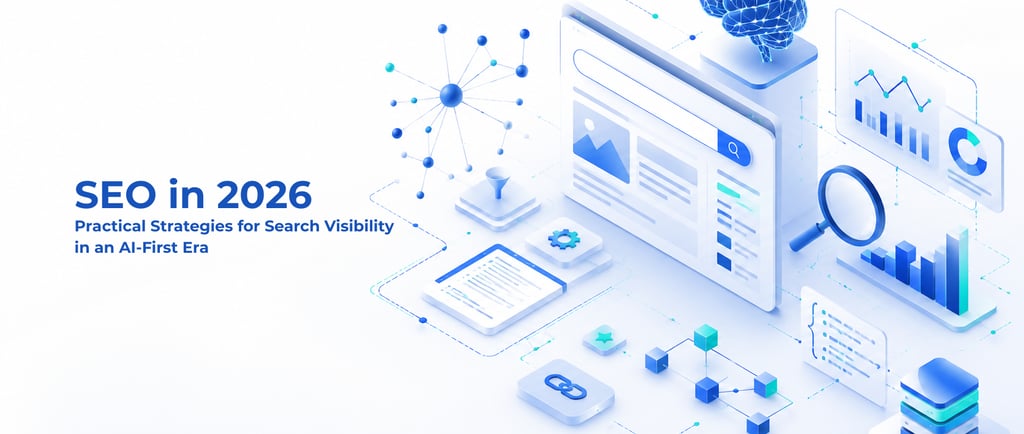
Practical Strategies for Search Visibility in an AI-First Era
SEO in 2026 sits at the intersection of traditional search fundamentals and rapidly evolving AI-driven systems. Organic rankings still depend on solid Technical SEO, On-page SEO, and Off-page SEO foundations, but AI Search Optimization and signals from large language models now shape visibility, click-through behavior, and even indexing priorities.
This guide covers actionable tactics — from keyword research and topical authority to Core Web Vitals and schema markup — tailored for 2026.
Technical SEO: crawlability, indexing, and platform health
Ensure crawlability and efficient indexing by keeping a clean robots.txt, up-to-date XML sitemap, and logical URL structure. In 2026, crawl allocation remains limited for some large sites, so prioritize high-value pages and use canonical tags to avoid duplicate content.
Monitor Google Search Console and server logs frequently to detect crawl errors, soft 404s, and indexing issues. Use the Coverage report, Page Experience data, and the new AI Insights sections in Search Console to understand how Google’s models view your site.
Optimize site architecture for fast discovery: flatten deep hierarchies, use consistent internal linking, and publish important pages within a few clicks from the homepage to maximize crawl priority.
Core Web Vitals and Page Experience
Core Web Vitals remain ranking and user-experience signals. Prioritize Largest Contentful Paint (LCP), Cumulative Layout Shift (CLS), and Interaction to Next Paint (INP) or First Input Delay (FID) replacement metrics depending on platform updates.
Use server-side rendering, edge caching, and optimized image formats (AVIF/WebP) to reduce LCP. Implement font-display strategies and reserve space for dynamic elements to minimize CLS.
Measure continuously with field data (Chrome UX Report), lab tests (Lighthouse), and Real User Monitoring (RUM) to spot regressions after feature launches.
On-page SEO, keyword research, and search intent
Move beyond single-keyword targets. Use keyword research to map phrases to search intent (informational, navigational, transactional, commercial investigation) and create content that satisfies intent at each funnel stage.
In 2026, AI-assisted keyword discovery tools synthesize SERP analysis, user engagement metrics, and voice-to-text queries. Integrate intent clusters into content plans rather than chasing search volume alone.
Optimize meta titles, descriptions, headers, and in-content variations for natural language and entity-based phrasing that aligns with AI models’ understanding of queries.
Content strategy: topical authority, content clusters, and internal linking
Build topical authority with content clusters: a pillar page covering a broad topic plus tightly related subpages that address specific intents. This signals depth to search engines and AI models assessing expertise and relevance.
Internal linking should follow a purposeful schema: link from pillar to cluster pages and vice versa, use descriptive anchor text, and avoid excessive site-wide footer links that dilute relevance.
Focus on quality signals that matter in 2026: original research, case studies, structured data, and clear author/credential attribution for YMYL topics.
Off-page SEO and backlink strategy
Backlinks remain a powerful relevance and trust signal, but quality outweighs quantity. Prioritize links from topically relevant, authoritative sites and avoid manipulative link schemes.
Complement classic link acquisition with digital PR, data-driven studies, and partnerships that produce natural mentions. Monitor backlink profiles for toxic links and disavow only when necessary.
Use backlink analysis to find content gap opportunities and to inform SERP analysis for competitive strategy.
Local SEO and enterprise SEO nuances
Local SEO: optimize Google Business Profiles, maintain consistent NAP (name, address, phone) data, solicit structured reviews, and use localized schema markup. In 2026, AI-powered local search blends on-page signals with user behavior and review sentiment to rank local results.
Enterprise SEO: address scale issues with automation and governance. Automate canonical handling, schema deployment, and index controls while keeping manual oversight for strategic pages. Use content templates, internal training, and a centralized taxonomy to maintain topical authority across thousands of pages.
AI SEO and AI Search Optimization
AI models now influence SERP features and answer surfaces. Optimize content for AI extraction by using clear structure, concise answers for featured snippets, and schema markup that surfaces entities and relationships.
Leverage AI for content ideation and production, but ensure human review for factual accuracy, originality, and brand voice. Search engines penalize or deprioritize low-quality AI-generated content that lacks added value.
Monitor new AI-specific ranking signals and experiment with content that addresses multimodal queries (text + image + audio) as search interfaces expand.
SERP analysis and competitive signals
Regular SERP analysis helps identify feature opportunities (knowledge panels, people also ask, rich results) and content formats that perform. Track click-through rates, zero-click trends, and the presence of AI-generated answer boxes.
Use competitor gap analysis to find topics where your site can create superior depth, visuals, or interactive tools that boost user engagement and topical authority.
Schema markup and structured data
Implement schema markup to clarify entities, relationships, and actions. Use Article, FAQ, HowTo, Product, LocalBusiness, and Review schemas as applicable, along with JSON-LD formats.
In 2026, schema remains critical for AI summarization and for powering rich results. Keep structured data accurate and regularly validated with tools (Search Console’s Rich Results test and schema validators).
Monitoring and tools: Google Search Console and beyond
Google Search Console remains the primary source of insight into indexing, performance, and issues. Combine GSC with analytics platforms, server logs, and AI-driven SEO tools for a full picture.
Track organic traffic, impressions, and position trends, but also measure engagement metrics (time on page, conversions) that indicate content usefulness and inform prioritization.
Indexing, sitemaps, and governance
Use XML sitemaps to signal canonical pages and update them dynamically for frequent changes. For very large sites, submit segmented sitemaps and use lastmod wisely to highlight recent updates.
Implement index management strategies: noindex for low-value pages, canonical tags for duplicates, and hreflang for multilingual sites to prevent wasteful crawling and diluted authority.
Putting it together: practical checklist for 2026
Audit crawlability: robots.txt, XML sitemap, and coverage in Search Console.
Improve Core Web Vitals: reduce LCP, fix CLS, implement RUM.
Map keywords to search intent and create content clusters for topical authority.
Use schema markup and structured data for AI extraction and rich results.
Build a quality backlink profile through relevance and PR-driven content.
Monitor performance with Google Search Console, analytics, and server logs.
Apply enterprise/local-specific governance: automation plus human oversight.
Use AI tools for ideation and optimization, but ensure human verification and unique value.
SEO in 2026 balances enduring fundamentals with AI-driven shifts. Technical health, well-structured content, and authoritative backlinks remain core, while AI Search Optimization, schema, and experience signals increasingly determine which pages the models surface. Focus on user intent, demonstrable expertise, and measurable experience improvements — and continually test, measure, and adapt as search evolves.
WHY US
Comprehensive solutions for your marketing needs.
Contact Us
Subscribe Now to Receive Exclusive Marketing Tips and Updates!
Hello@1stopshop4marketing.com
0091 9867000502
© 2026. All rights reserved.