The Complete SEO Checklist for 2026
50+ Tasks Every SEO Professional Must Do
SEO
Gagan Gujral
7/22/20265 min read

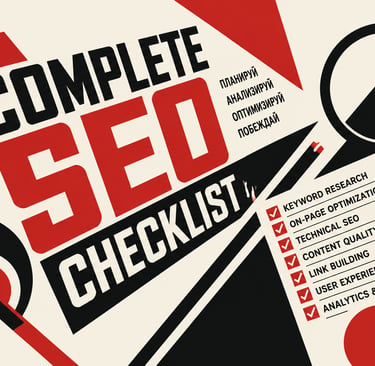
A complete, actionable SEO checklist covering technical SEO, keyword research, on-page optimization, content strategy, link building, local SEO, and analytics — everything you need to rank higher in 2026.
Search engine optimization isn't a one-time task — it's an ongoing discipline made up of dozens of small, specific actions that compound over time. Whether you're an in-house marketer, an agency SEO, or a freelancer managing multiple clients, having a repeatable checklist keeps you from missing the details that actually move rankings.
This guide breaks SEO down into eight core categories, with a practical, no-fluff checklist for each one. Bookmark it, print it, or turn it into your monthly audit template.
Table of Contents
1. Technical SEO {#technical-seo}
Technical SEO is the foundation everything else sits on. If search engines can't crawl and render your site properly, great content and backlinks won't matter.
Audit crawlability — check your robots.txt file to make sure it isn't accidentally blocking important pages.
Submit and maintain an XML sitemap in Google Search Console and Bing Webmaster Tools.
Find and fix broken links (both internal and outbound) using a crawler like Screaming Frog or Ahrefs Site Audit.
Resolve 404 errors by redirecting them to relevant live pages.
Improve Core Web Vitals — Largest Contentful Paint (LCP), Interaction to Next Paint (INP), and Cumulative Layout Shift (CLS).
Compress and lazy-load images to cut page weight.
Confirm mobile-friendliness using Google's mobile-friendly testing tools; design mobile-first if possible.
Enforce HTTPS site-wide and fix any mixed-content warnings.
Eliminate duplicate content with canonical tags (rel="canonical").
Clean up redirect chains — a page should never need more than one hop to reach its final destination.
Add structured data (schema markup) for articles, products, FAQs, reviews, and breadcrumbs to enable rich results.
Check indexation status — use site:yourdomain.com searches and Search Console's Coverage report to confirm important pages are indexed.
Fix crawl errors and server errors (5xx) flagged in Search Console.
Flatten site architecture so any page is reachable within 3-4 clicks from the homepage.
Set up an XML sitemap for images and video if visual content matters to your traffic.
2. Keyword Research {#keyword-research}
Keyword research tells you what to create and why people are searching for it.
Identify seed keywords relevant to your business or niche.
Expand into long-tail variations — these convert better and face less competition.
Classify search intent for each keyword: informational, navigational, commercial, or transactional.
Analyze competitor keyword rankings to find gaps you can exploit.
Group keywords into topic clusters built around a central pillar page.
Check keyword difficulty and search volume using tools like Ahrefs, Semrush, or Google Keyword Planner.
Prioritize keywords by business value, not just volume — a lower-volume keyword with high buyer intent often outperforms a broad, competitive one.
Track "question" keywords (who, what, why, how) to feed FAQ sections and featured snippet opportunities.
3. On-Page SEO {#on-page-seo}
On-page SEO makes sure every individual page is optimized to rank for its target keyword — and to satisfy the person who lands on it.
Write unique, keyword-optimized title tags (ideally 50-60 characters).
Craft compelling meta descriptions (150-160 characters) that drive clicks, even though they aren't a direct ranking factor.
Use one clear H1 per page, followed by a logical H2/H3 hierarchy.
Optimize images with descriptive file names and alt text.
Naturally incorporate target and related keywords — avoid keyword stuffing.
Build internal links from relevant existing pages to new content, and vice versa.
Match content to search intent — a "best X" query needs a listicle/comparison, not a product page.
Add FAQ sections targeting question-based keywords for featured snippet potential.
Optimize URL slugs to be short, descriptive, and keyword-relevant.
Ensure readability — short paragraphs, bullet points, and clear formatting.
Add a clear call-to-action appropriate to the page's intent.
4. Content Strategy {#content-strategy}
Content is what earns rankings, links, and shares over time.
Run a content gap analysis against top-ranking competitors.
Build a content calendar aligned to keyword clusters and business priorities.
Publish original, in-depth content that goes beyond what's already ranking.
Refresh and update older posts with new data, examples, and keywords.
Consolidate thin or overlapping pages into stronger, comprehensive ones.
Build pillar pages and topic clusters to establish topical authority.
Add original data, visuals, or case studies to differentiate from competitors.
Repurpose top content into other formats (video, infographic, social posts) to extend reach.
5. Off-Page SEO & Link Building {#off-page-seo}
Off-page signals — especially backlinks — remain one of the strongest ranking factors.
Audit your current backlink profile for quality and relevance.
Analyze competitor backlinks to find replicable link opportunities.
Pursue guest posting on reputable, relevant sites.
Build linkable assets — original research, tools, or comprehensive guides that naturally attract links.
Do digital PR outreach to earn mentions from journalists and industry publications.
Reclaim unlinked brand mentions by reaching out and asking for a link.
Disavow toxic or spammy backlinks that could be harming your profile.
Build citations and directory listings relevant to your industry.
6. Local SEO {#local-seo}
If you serve a physical location or region, local SEO deserves its own workflow.
Fully optimize your Google Business Profile (categories, hours, photos, services).
Maintain NAP consistency (Name, Address, Phone) across your site and all directories.
Get listed in relevant local and industry directories.
Actively collect and respond to customer reviews.
Create location-specific landing pages for multi-location businesses.
Earn local backlinks from community organizations, local press, and partners.
7. Analytics & Reporting {#analytics-reporting}
You can't improve what you don't measure.
Set up and maintain Google Analytics (GA4) goal/conversion tracking.
Monitor Google Search Console weekly for performance, coverage, and manual actions.
Track keyword rank movement over time.
Monitor organic traffic trends by landing page and segment.
Measure conversions and revenue attributable to organic search.
Run a full SEO audit monthly or quarterly.
Benchmark performance against competitors regularly.
Build a recurring stakeholder report that ties SEO metrics to business outcomes.
8. Ongoing Maintenance {#ongoing-maintenance}
SEO is never "done." These are the recurring tasks that keep gains from eroding.
Track major Google algorithm updates and audit affected pages after each rollout.
Monitor for manual actions or security issues in Search Console.
Periodically prune thin, outdated, or duplicate content.
Re-check sitemap and robots.txt whenever the site structure changes.
Re-evaluate keyword strategy quarterly as search trends shift.
FAQ {#faq}
How often should I run through this SEO checklist? Technical checks and analytics reviews work well as weekly or monthly habits. Deeper items — full audits, content gap analysis, backlink reviews — are typically done quarterly.
What's the single highest-impact task on this list? It depends on your site's current weaknesses, but for most sites, fixing technical crawlability issues and aligning content with search intent deliver the fastest, most reliable gains.
Do I need to do local SEO if I'm not a local business? No — skip that section entirely if you don't serve a specific geographic area or have a physical location.
How long does SEO take to show results? Most sites start seeing measurable movement in 3-6 months, with more significant results compounding over 6-12 months, depending on competition and starting authority.
Use this checklist as a living document — copy it into your project management tool, assign owners to each section, and revisit it every audit cycle.
WHY US
Comprehensive solutions for your marketing needs.
Contact Us
Subscribe Now to Receive Exclusive Marketing Tips and Updates!
Hello@1stopshop4marketing.com
0091 9867000502
© 2026. All rights reserved.