
The New Design Advantage
Blog post description.
UI AND UX
7/7/20265 min read
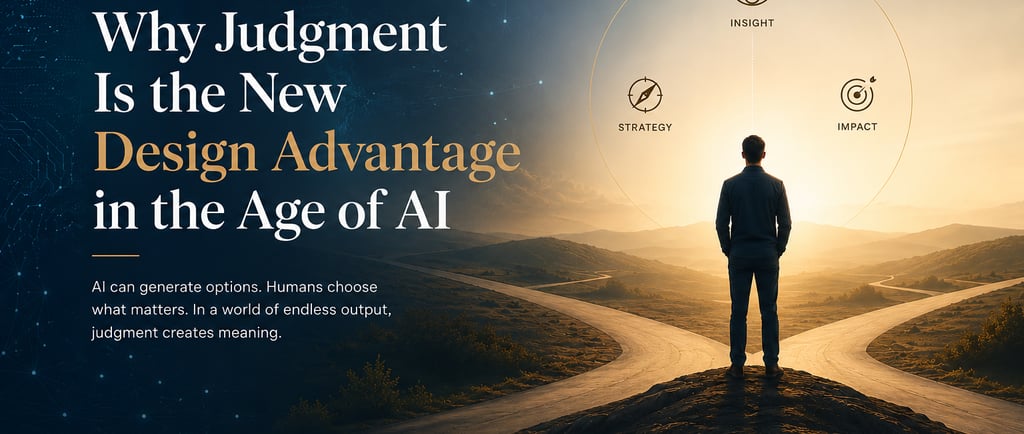
Why Judgment Has Become More Valuable Than Execution in the Age of AI
By Gagan Gujral
Introduction: The End of Design as We Knew It?
For decades, success in design was measured by execution.
Could you create pixel-perfect mockups? Did you know Photoshop shortcuts by heart? Could you build responsive websites from scratch? How quickly could you translate a client's vision into a polished interface?
These were the skills that differentiated professionals from beginners.
Today, that equation is changing.
Artificial Intelligence can generate website layouts, mobile interfaces, illustrations, marketing assets, icons, and even production-ready code within minutes. Tools like Figma AI, Cursor, Claude, ChatGPT, Lovable, v0, and other AI-powered design platforms have dramatically reduced the time required to move from an idea to a working prototype.
Naturally, this has led to a question many designers, developers, and marketers are asking:
If AI can execute the work, what is left for humans?
The answer is surprisingly encouraging.
AI is not replacing the need for designers—it is changing what makes a designer valuable.
The future belongs less to people who can execute every detail manually and more to those who can think strategically, exercise sound judgment, and guide AI toward meaningful outcomes.
Execution is becoming a commodity.
Judgment is becoming the premium skill.
From Craftsmanship to Creative Direction
Think about architecture.
Architects rarely lay every brick themselves. Their expertise lies in understanding space, structure, aesthetics, functionality, regulations, and human behavior. Builders execute the plans.
Design is moving in a similar direction.
AI has become an incredibly fast builder.
It can generate dozens of layouts in seconds. It can suggest typography, color palettes, create illustrations, write code, and even produce marketing copy.
But someone still has to decide:
Which concept best represents the brand?
Which layout supports user goals?
Which visual hierarchy improves comprehension?
Which design builds trust?
Which interface is accessible?
Which experience actually converts visitors into customers?
Those decisions require human judgment.
Instead of spending hours aligning pixels, designers increasingly spend time evaluating options, refining ideas, and making strategic decisions.
The role shifts from operator to director.
Why Good Taste Has Become a Competitive Advantage
One of AI's greatest strengths is also one of its greatest weaknesses.
It produces designs based on patterns it has already seen.
This means AI is exceptionally good at creating designs that look familiar.
It is far less capable of creating work that feels genuinely distinctive.
That is where taste becomes valuable.
Taste is difficult to define, but easy to recognize.
It is the ability to understand why one design feels calm while another feels chaotic.
It is knowing when typography communicates confidence instead of clutter.
It is understanding how spacing affects perception.
It is recognizing when simplicity creates elegance rather than emptiness.
No prompt can replace years spent studying visual communication, editorial design, branding, photography, architecture, or user experience.
AI generates possibilities.
Humans decide which possibilities deserve to exist.
Business Thinking Is Becoming More Important Than Software Skills
Many designers still focus primarily on visual aesthetics.
Businesses, however, invest in design for entirely different reasons.
They want more sales.
More leads.
Better retention.
Higher engagement.
Greater trust.
Better customer experiences.
Design is ultimately a business tool.
A visually stunning website that fails to communicate value or encourage action has not succeeded.
Conversely, a relatively simple interface that helps users complete tasks effortlessly often generates far greater business value.
The designers who thrive in the AI era will understand questions like:
What problem are we solving?
Who is this user?
What motivates them?
What objections do they have?
How do we reduce friction?
How do we increase confidence?
What action should happen next?
These questions cannot be answered through software alone.
They require empathy, psychology, strategy, and business understanding.
Prompt Engineering Is Temporary. Creative Direction Is Permanent.
There was a time when "prompt engineering" was considered one of the most valuable AI skills.
As AI models become increasingly sophisticated, that importance is already beginning to fade.
Modern AI understands natural language remarkably well.
The real differentiator is no longer writing complicated prompts.
It is providing clear creative direction.
Consider these two instructions.
The first:
Design a homepage.
The second:
Design a homepage for a premium B2B cybersecurity company targeting enterprise CIOs. The interface should communicate trust, stability, and expertise. Reduce unnecessary visual noise, emphasize social proof, create a clear content hierarchy, and make the call-to-action unmistakable.
The difference is not prompt engineering.
It is strategic thinking.
People who understand audiences, brands, positioning, and communication will consistently produce stronger AI-assisted work than those who simply know prompting techniques.
Design Systems Become Even More Valuable
Generating a single beautiful screen is relatively easy.
Maintaining consistency across hundreds of screens is not.
Large digital products require:
reusable components
spacing systems
typography scales
color tokens
interaction patterns
accessibility standards
governance
documentation
AI can generate individual screens quickly.
Maintaining a coherent design language across an entire product ecosystem still requires human oversight.
This is why design systems are becoming increasingly important.
Rather than replacing designers, AI increases the value of those who think systematically.
UX Strategy Cannot Be Automated
Artificial Intelligence excels at execution.
It struggles with ambiguity.
Real design problems rarely begin with visuals.
They begin with questions.
Why are customers abandoning checkout?
Why is engagement declining?
Why are users confused?
Why is adoption low?
These problems require research.
Interviews.
Observation.
Behavior analysis.
Testing.
Iteration.
Good UX starts with understanding people—not pixels.
AI can summarize research findings.
It cannot replace human conversations or interpret complex emotions, motivations, and cultural contexts with the same depth.
Strategy remains profoundly human.
Front-End Knowledge Is Still a Superpower
Some believe AI eliminates the need to learn HTML, CSS, or JavaScript.
The opposite is often true.
Basic technical literacy allows designers to:
recognize poor semantic HTML
identify accessibility issues
detect inefficient CSS
improve responsive behavior
optimize performance
collaborate effectively with developers
Without foundational knowledge, many people assume AI-generated code is correct simply because it works.
Experienced professionals recognize that working code is not always good code.
The goal is not necessarily writing every line manually.
The goal is understanding what AI has written.
Accessibility Is More Important Than Ever
AI frequently produces interfaces that appear attractive while overlooking essential accessibility principles.
Examples include:
poor color contrast
incorrect heading hierarchy
inaccessible forms
missing keyboard navigation
inadequate screen reader support
unclear focus states
Accessibility is not merely compliance.
It is good design.
Designers who understand inclusive experiences will remain indispensable regardless of how sophisticated AI becomes.
Research and User Psychology Remain Human Advantages
Exceptional products rarely emerge from software alone.
They emerge from understanding people.
Successful designers study:
human behavior
decision making
trust formation
cognitive load
motivation
emotional response
user expectations
AI recognizes patterns.
Humans recognize meaning.
That distinction will continue to matter.
Storytelling Is the Invisible Layer of Great Design
Every interface tells a story.
The order of information.
The emphasis of headlines.
The placement of testimonials.
The timing of interactions.
The sequence of pages.
Together they create a narrative.
Visitors move from curiosity to understanding, from uncertainty to confidence, from hesitation to action.
Storytelling influences every one of those transitions.
AI can arrange elements on a page.
Humans decide what story those elements should tell.
Skills Becoming More Valuable
Professionals entering design today should prioritize developing:
Strategic thinking
Business understanding
User psychology
Information architecture
Visual taste
Typography
Design systems
Accessibility
AI collaboration
Technical literacy
Communication
Research skills
Critical thinking
These capabilities become stronger when combined rather than mastered in isolation.
Skills Becoming Less Central
Some traditional tasks are increasingly automated:
Manual wireframing
Pixel-perfect production work
Repetitive asset creation
Memorizing CSS syntax
Building every interface component from scratch
Creating multiple design variations manually
These skills still matter, but they no longer define expertise.
The Designer of the Future
The designer of tomorrow will resemble a strategist more than a software operator.
They will combine creativity with business understanding.
They will understand customers as deeply as interfaces.
They will use AI as an amplifier rather than a replacement.
Most importantly, they will know how to evaluate ideas rather than simply generate them.
Because in a world where everyone has access to powerful AI, generating options becomes easy.
Choosing the right option becomes difficult.
That is where expertise lives.
Conclusion: Judgment Is the Last Competitive Advantage
Every technological revolution changes the value of human skills.
The Industrial Revolution reduced the value of manual labor.
The Internet reduced the value of information scarcity.
Artificial Intelligence is reducing the value of routine execution.
What remains valuable is judgment.
The ability to ask better questions.
To recognize quality.
To understand people.
To solve business problems.
To communicate ideas clearly.
To build trust.
To make thoughtful decisions when countless possibilities exist.
AI will continue to become faster, cheaper, and more capable.
But no matter how advanced it becomes, it will still need someone to decide what is worth building.
That responsibility—and that opportunity—belongs to humans.
The future of design is not about competing with AI.
It is about becoming the kind of professional who knows how to lead it.
WHY US
Comprehensive solutions for your marketing needs.
Contact Us
Subscribe Now to Receive Exclusive Marketing Tips and Updates!
0091 9867000502
© 2024. All rights reserved.