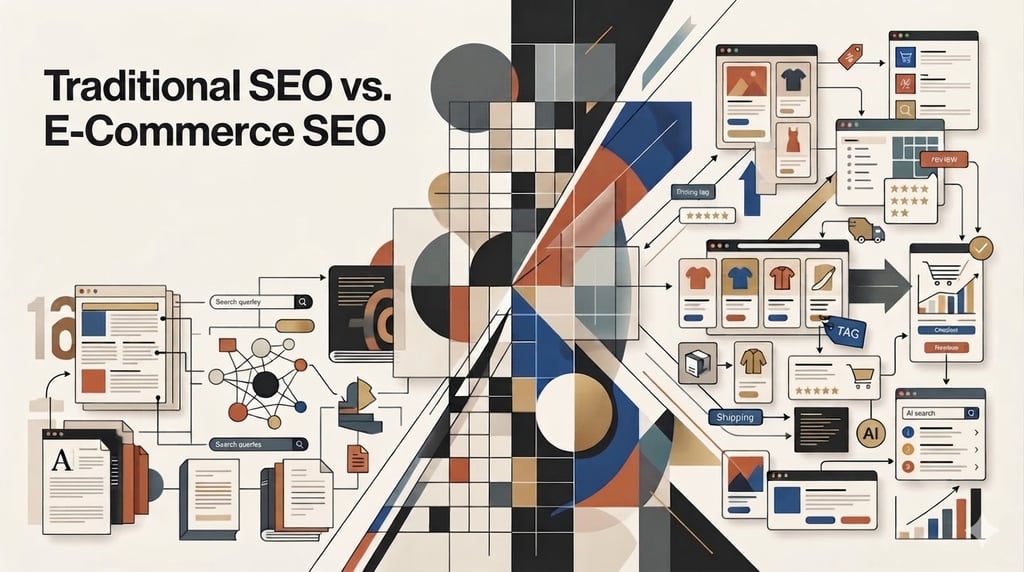
Traditional SEO vs. E-Commerce SEO
Discover the key differences between SEO vs eCommerce SEO and learn why treating them the same could cost your business traffic, rankings, and revenue.
SEO
Gagan Gujral
7/31/20268 min read
Ask ten executives to define "SEO," and most will describe the same thing: rank higher on Google, drive organic traffic, grow the business. It's a clean story, and it's incomplete. In my years teaching digital strategy and advising companies on growth, the single most expensive misconception I encounter in the C-suite is this: that SEO for a media site, a SaaS company, and an online store are fundamentally the same discipline, just applied to different websites.
They are not. Regular SEO and e-commerce SEO share a technical foundation, but they optimize for different outcomes, different buyer psychology, and different points in the business's revenue engine. Conflating them leads to misallocated budgets, misaligned KPIs, and content teams celebrating traffic numbers that never convert into revenue. This article lays out the distinction in terms that matter at the strategic level: where the two disciplines diverge, and what that divergence should mean for how you resource and measure your SEO investment.
The Core Distinction: Authority vs. Intent-to-Purchase
Regular SEO — the kind practiced by publishers, B2B service firms, and content-led brands — is fundamentally an authority-building exercise. If you're unsure which category your business falls into, our eCommerce SEO team can help you map your current strategy before you scale spend in the wrong direction.
The goal is to become the trusted, comprehensive answer to a question, and to accumulate the topical depth and backlink profile that search engines reward with visibility over time. Success is measured in rankings, referral traffic, brand awareness, and lead generation further down a long consideration funnel.
E-commerce SEO is an intent-to-purchase capture exercise. The searcher isn't researching a concept; they are actively shopping. They have a wallet open, a comparison tab running, and a narrow window of patience. The job of e-commerce SEO is not to educate them over months — it's to be the product they find, trust, and buy in minutes. This single difference in the state of the buyer's mind cascades into nearly every operational decision that follows.
Where the Two Disciplines Actually Diverge
1. The Unit of Optimization
In regular SEO, the primary unit of optimization is the page — usually a blog post, guide, or landing page built around a keyword cluster. In e-commerce SEO, the primary unit is the product or category page, and increasingly, an entire catalog of thousands or millions of near-duplicate SKUs. A publisher might manage a few hundred strategic pages. A mid-sized retailer might manage two hundred thousand. That scale difference alone changes the entire operating model — from manual optimization to templated, rules-based, and often automated optimization across product feeds, structured data, and category taxonomies.
2. Keyword Strategy
Regular SEO chases informational and navigational keywords — "how to," "what is," "best practices for." E-commerce SEO chases transactional and commercial-investigation keywords — "buy," "price," "near me," "[brand] vs [brand]," and increasingly, long-tail queries with modifiers like size, color, or material. The keyword research tools may look similar, but the intent layer requires an entirely different filter. Ranking a product page for an informational query often means you've attracted a visitor who has no intention of buying today.
3. Conversion Signals and Trust Architecture
A content page earns trust through expertise and citations. A product page earns trust through reviews, ratings, return policies, shipping transparency, stock availability, and price competitiveness. Google's algorithms have adapted accordingly: for commercial queries, the search engine weighs signals like review volume, merchant reputation, structured product data, and even real-time pricing far more heavily than it does for informational queries. This means your SEO team's job expands to include things a traditional content strategist never touches — review generation, schema markup for pricing and availability, and coordination with merchandising.
4. Technical SEO Complexity
Regular SEO's technical concerns center on site speed, crawlability, and internal linking across a relatively stable set of URLs. E-commerce SEO inherits all of that and adds a distinct set of structural problems:
Faceted navigation and duplicate content — filters for size, color, and price can generate millions of near-identical URLs that dilute crawl budget and cannibalize rankings if not handled with canonicalization and careful indexation rules.
Out-of-stock and discontinued product handling — a decision as simple as "what happens to a product page when the item sells out" has direct SEO and revenue consequences at scale.
Pagination and category depth — how deep a shopper has to click to find a product affects both crawlability and conversion.
Site migrations and seasonal catalogs — retailers relaunch collections and rotate inventory constantly, each event carrying redirect and indexation risk that a static content site rarely faces.
Faceted navigation, out-of-stock handling, and seasonal catalog migrations are exactly the kind of technical debt we help e-commerce clients untangle as part of our eCommerce SEO services.
5. Content's Role
In regular SEO, content is the product — the article is the destination. In e-commerce SEO, content is a support structure around the actual product: buying guides, comparison content, and category descriptions exist to funnel intent-rich traffic toward a purchase, not to hold attention indefinitely. Time-on-page, a prized metric for publishers, can be almost meaningless for a retailer — a fast, decisive path to checkout is often the better outcome.
6. Measurement and ROI
This is where the boardroom conversation matters most. Regular SEO is typically measured against traffic,
rankings,
share of voice,
and marketing-qualified leads
— proxies for a value that is realized later in the funnel.
E-commerce SEO can and should be measured against
revenue per organic session,
organic-assisted conversion rate,
and category-level revenue contribution.
If your organic search reporting stops at "sessions" and "keyword rankings" for a retail business, you are measuring the wrong layer of the funnel and likely under- or over-investing as a result.
Why This Distinction Should Change How You Lead
For business leaders, the practical implications are threefold:
Resourcing. A generalist content-marketing SEO hire is not automatically equipped to manage a 100,000-SKU catalog. E-commerce SEO increasingly overlaps with data engineering, feed management, and marketplace strategy (Google Shopping, Amazon, retail media). Budget and hiring plans should reflect that this is closer to a technical-commercial discipline than a content discipline.
Governance. Because e-commerce SEO touches pricing, inventory, and merchandising data in real time, it cannot sit in a silo separate from commercial operations. The most effective retail organizations I've studied treat SEO as a shared function between marketing and merchandising, not a marketing-only line item.
Metrics that reach the P&L. Executives should push their teams past vanity traffic metrics and demand revenue-attributed SEO reporting. A 20% increase in organic traffic to a blog is a leading indicator. A 20% increase in organic revenue to a category page is the number that belongs in a board deck.
Not sure which kind of SEO your business needs?
If your store is generating traffic that isn't converting, or your SEO reporting stops at rankings instead of revenue, that's usually a sign the strategy hasn't caught up to how e-commerce SEO actually works.
See how we approach eCommerce SEO →
Conclusion
Regular SEO and e-commerce SEO both live under the same three-letter acronym, and both depend on the same search engines, but they are answering different business questions. One builds authority and demand over time. The other captures already-formed intent and converts it into revenue, at a scale and technical complexity that most content-first playbooks were never built to handle.
The leaders who get the most out of their SEO investment are the ones who stop asking "are we doing SEO well?" and start asking the more precise question: "are we doing the right kind of SEO for how our business actually makes money?"
For a retailer, the answer determines whether search is a brand-awareness channel — or your most efficient, highest-margin sales channel.
If you want a straight answer for your business, talk to our SEO team — we'll tell you honestly which category you're in and what to fix first.
Frequently Asked Questions About E-commerce SEO
How can I improve search rankings for an online retail product?
Improving the rankings of a product page isn't about stuffing keywords into the title anymore. Search engines want to see that your product page genuinely helps shoppers make a buying decision.
A well-optimized product page should include:
A unique product title
Original product descriptions (not copied from manufacturers)
High-quality images with descriptive alt text
Product reviews and ratings
Product Schema markup
Fast loading speeds
Clear pricing and stock availability
Internal links from relevant categories and buying guides
The stronger the overall shopping experience, the stronger your SEO signals become.
How do I improve product page SEO for an online store?
Think beyond keywords.
A product page should answer every question a customer might have before buying.
That means including:
Features and benefits
Technical specifications
FAQs
Shipping information
Return policy
Customer reviews
Product videos
Comparison tables where appropriate
Google increasingly rewards pages that reduce uncertainty and provide a complete shopping experience.
What are the best practices for writing SEO-friendly product descriptions?
Avoid copying the manufacturer's description.
Instead:
Write original content
Explain benefits, not just features
Naturally include primary and related keywords
Break content into short sections
Use bullet points for readability
Answer common customer questions
Mention materials, dimensions, colours, compatibility, warranty and use cases where relevant
The goal is to help both search engines understand the page and customers feel confident enough to purchase.
Does AI help with e-commerce SEO?
Yes—but only when it's used thoughtfully.
AI can help you:
Generate product description drafts
Discover keyword opportunities
Create category page content
Cluster products intelligently
Generate schema markup
Identify internal linking opportunities
Analyse competitors
Detect duplicate content
However, AI shouldn't replace human expertise.
The best-performing stores combine AI efficiency with human editing to ensure product information is accurate, trustworthy and genuinely useful.
What is AI-powered e-commerce SEO optimization?
AI-powered e-commerce SEO refers to using artificial intelligence to automate and improve SEO tasks across large product catalogues.
Instead of manually optimising thousands of products, AI can help:
Generate optimized metadata
Improve product titles
Suggest missing keywords
Optimise image alt text
Create FAQs
Detect thin content
Recommend internal links
Analyse search intent
Identify pages losing rankings
For stores with hundreds or thousands of products, AI significantly reduces manual work while maintaining consistency.
What are the best practices for e-commerce SEO?
Some of the most effective e-commerce SEO practices include:
Create a logical category hierarchy
Optimise every product page individually
Avoid duplicate content
Use Product Schema markup
Improve Core Web Vitals
Optimise images without sacrificing quality
Build strong internal links
Encourage authentic customer reviews
Maintain clean URL structures
Fix broken pages and redirects
Manage faceted navigation carefully
Keep XML sitemaps updated
Monitor index coverage regularly
Successful e-commerce SEO is a combination of technical optimisation, content quality and user experience.
Is product schema important for e-commerce SEO?
Absolutely.
Product Schema helps search engines understand key information such as:
Price
Availability
Ratings
Reviews
Brand
SKU
Product variants
When implemented correctly, it can improve eligibility for rich search results, making your listings more informative and potentially increasing click-through rates.
How important are customer reviews for SEO?
Reviews play an important role for both users and search engines.
They:
Build trust
Add fresh content to product pages
Naturally include long-tail keywords
Improve conversion rates
Strengthen product credibility
While reviews aren't a magic ranking factor on their own, they contribute to a better overall experience, which supports long-term SEO performance.
Should every product have its own unique description?
Yes.
Using manufacturer descriptions across hundreds of products creates duplicate content and makes it difficult for search engines to understand why your page deserves to rank.
Unique descriptions help differentiate your products and give customers more useful information.
How long does e-commerce SEO take to show results?
SEO is a long-term investment.
Depending on your competition, website authority and technical health, many online stores begin seeing measurable improvements within three to six months, while more competitive markets can take six to twelve months or longer.
The advantage is that unlike paid advertising, the value of strong SEO compounds over time.
Is category page SEO more important than product page SEO?
Both matter, but they serve different purposes.
Category pages usually target broader commercial keywords like:
Running shoes
Office chairs
Men's leather wallets
Product pages target specific buying intent such as:
Nike Air Zoom Pegasus 42 Men's Running Shoes Size 10
A strong e-commerce SEO strategy optimises both, allowing category pages to capture broader searches while product pages convert highly specific purchase intent.
What's the biggest mistake businesses make with e-commerce SEO?
Many businesses treat an online store like a blog.
They invest heavily in articles while neglecting the pages that actually generate revenue.
The highest ROI often comes from improving:
Product pages
Category pages
Site architecture
Internal linking
Structured data
Shopping experience
Traffic is valuable—but only if it leads to sales.
WHY US
Comprehensive solutions for your marketing needs.
Contact Us
Subscribe Now to Receive Exclusive Marketing Tips and Updates!
Hello@1stopshop4marketing.com
0091 9867000502
© 2026. All rights reserved.