
How Much Does an SEO Agency Cost in 2026?
Not all SEO agencies charge the same—and for good reason. Discover how much an SEO agency costs in 2026, compare pricing models, understand what influences SEO costs, and learn how to choose the right agency for long-term growth.
SEO
Gagan Gujral
7/10/20269 min read


If you're researching SEO agency pricing, you've probably noticed something confusing: one agency quotes ₹20,000 per month, while another recommends ₹2,00,000 or more for what appears to be the same service.
So, why the huge difference?
The truth is that SEO isn't a fixed-cost service. Pricing depends on your business goals, website size, industry competition, content requirements, technical complexity, and the experience of the agency you hire. A local business looking to rank in one city has very different needs from an eCommerce brand competing nationally or an enterprise managing thousands of web pages.
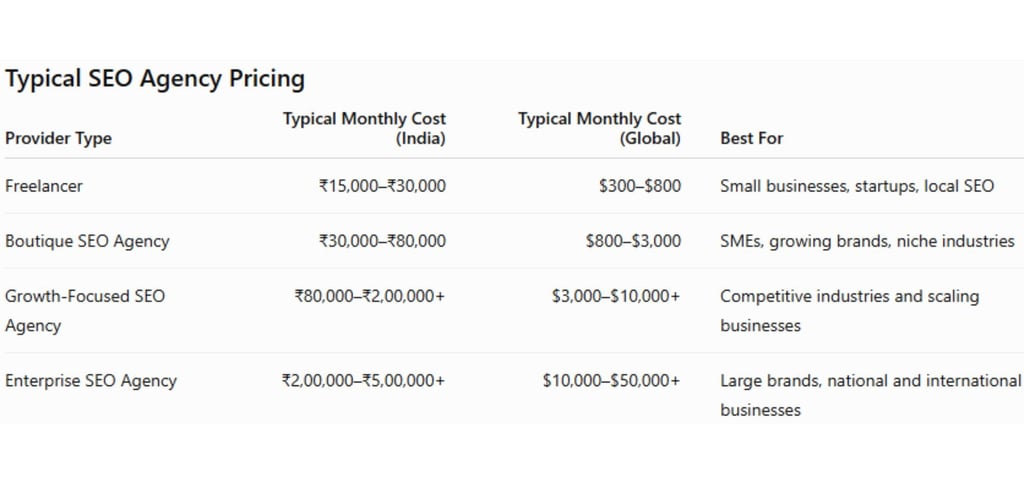
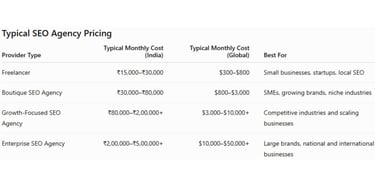
To help you benchmark realistic costs, we've compiled the typical monthly pricing ranges you'll see across India and international markets.
These figures should be viewed as industry benchmarks rather than fixed rates. The right investment depends on the scope of work, not just the provider's label.
A realistic view of SEO pricing in India
Most reputable SEO agencies in India charge between ₹25,000 and ₹2,00,000+ per month, depending on the complexity of the campaign.
At the lower end, businesses typically receive support for local SEO, basic technical optimisation, keyword research, and limited content creation. As budgets increase, agencies can invest in more advanced technical SEO, comprehensive content strategies, authority building, conversion optimisation, and AI Search Optimisation.
While it may be tempting to choose the cheapest option, businesses should be cautious of packages priced below ₹20,000 per month. At that level, it's extremely difficult to consistently fund the combination of technical improvements, high-quality content, strategic link acquisition, reporting, and ongoing optimisation required to generate sustainable organic growth.
In many cases, businesses aren't paying less—they're simply receiving fewer hours of expert work.
Other Common SEO Pricing Models
Not every business needs an ongoing monthly retainer. Depending on your objectives, agencies may also offer project-based or consulting engagements.
One-Time SEO Audit
A comprehensive SEO audit evaluates your website's technical health, content quality, on-page optimisation, user experience, and organic performance. These audits are often the first step before implementing a long-term SEO strategy.
Typical pricing
India: ₹40,000–₹3,00,000
Global: $1,000–$10,000+
Pricing depends largely on the number of pages, technical complexity, and the depth of analysis provided.
Project-Based SEO
Some businesses require SEO support for specific initiatives rather than ongoing optimisation. Common examples include website migrations, redesigns, large-scale content projects, or launching new product categories.
Typical pricing
India: ₹50,000 to several lakhs
Global: $2,000–$50,000+
Projects involving complex technical implementations or large websites naturally require higher budgets.
Hourly SEO Consulting
Experienced SEO consultants are often engaged to review existing strategies, solve technical challenges, or provide strategic guidance to in-house marketing teams.
Typical pricing
India: ₹2,000–₹10,000+ per hour
Global: $75–$500+ per hour
Hourly consulting is particularly useful when businesses already have an internal marketing team but need specialist expertise.
What Determines SEO Agency Pricing?
Now that you have a benchmark for typical SEO costs, the next question is why one business pays ₹30,000 per month while another invests ₹3,00,000 or more.
The answer lies in the complexity of the work involved.
In the next section, we'll explore the six biggest factors that influence SEO pricing, including website size, content requirements, technical SEO, authority building, and whether you're targeting local, national, or international markets.
What Determines SEO Agency Pricing?
Now that you have a benchmark for typical SEO costs, the next question is why one business pays ₹30,000 per month while another invests ₹3,00,000 or more.
The answer lies in the complexity of the work involved.
In the next section, we'll explore the six biggest factors that influence SEO pricing, including website size, content requirements, technical SEO, authority building, and whether you're targeting local, national, or international markets.
Section 2: What Factors Influence SEO Agency Pricing?
If you've requested quotes from multiple SEO agencies, you've probably noticed that pricing can vary dramatically. One agency might propose a modest monthly retainer, while another recommends a significantly larger investment for what appears to be the same goal—improving your search rankings.
So, what explains the difference?
The answer lies in the scope and complexity of the work. SEO is not a standardized service with fixed pricing. Every business has different objectives, technical challenges, competitive landscapes, and growth ambitions. An agency pricing a local business campaign will allocate its resources very differently from one managing SEO for a multinational eCommerce brand.
Understanding these pricing factors will help you compare proposals more effectively and choose an SEO partner based on value rather than price alone.
1. Website Size and Complexity
One of the biggest factors influencing SEO pricing is the size of your website.
A small local business website with 20 to 30 pages requires a very different level of effort than an eCommerce store with thousands of product pages or a SaaS platform with extensive documentation, knowledge bases, and landing pages.
As websites grow, so does the amount of work required to:
Crawl and audit thousands of URLs
Identify duplicate or thin content
Improve internal linking
Optimize site architecture
Manage indexation issues
Monitor crawl efficiency
Large websites also require ongoing technical maintenance as new pages are published, products are added, or site structures evolve.
For this reason, enterprise websites often invest significantly more in SEO simply to maintain technical health and organic visibility.
2. Content Creation Requirements
Content is one of the largest ongoing investments in any successful SEO strategy.
Modern SEO is no longer about publishing occasional blog posts. Businesses competing in organic search need comprehensive, high-quality content that demonstrates expertise and satisfies user intent across every stage of the buying journey.
Depending on your industry, an SEO campaign may include:
Educational blog articles
Service pages
Landing pages
Product descriptions
Comparison pages
Buying guides
Industry resources
Frequently asked questions (FAQs)
Creating this content requires research, strategy, writing, editing, optimization, and regular updates.
Agencies offering lower-cost SEO packages often produce little or no original content, while higher-tier retainers typically include an ongoing content strategy designed to build topical authority and long-term organic growth.
3. Technical SEO Requirements
Not every website presents the same technical challenges.
Some businesses operate on relatively simple websites, while others rely on complex platforms that require specialist technical expertise.
Technical SEO may involve:
Improving Core Web Vitals
Optimizing page speed
Resolving crawl errors
Managing JavaScript rendering
Implementing structured data
Fixing duplicate content
Optimizing XML sitemaps
Supporting website migrations
Configuring international SEO
The more technically complex a website becomes, the greater the time investment required from experienced SEO specialists.
This is one of the primary reasons enterprise SEO services command higher fees than basic local SEO campaigns.
4. Competition Within Your Industry
Ranking for highly competitive keywords requires considerably more work than ranking in a niche market.
For example, competing for search terms related to finance, legal services, healthcare, software, insurance, or digital marketing often means going up against businesses that have invested in SEO for years.
In these markets, success typically requires:
Extensive keyword research
Comprehensive content production
High-authority backlinks
Continuous technical optimization
Regular content updates
Ongoing performance analysis
Less competitive industries may achieve meaningful results with a smaller investment, while highly competitive sectors often require a much larger monthly budget to gain visibility.
5. Authority Building and Link Acquisition
Google continues to value websites that demonstrate trust, authority, and credibility.
Building that authority requires more than simply acquiring backlinks. Sustainable SEO focuses on earning high-quality mentions and links from relevant, reputable websites through valuable content and genuine digital PR efforts.
An effective authority-building strategy may include:
Digital PR campaigns
Industry outreach
Guest contributions
Original research
Data studies
Shareable resources
Link-worthy content assets
Be cautious of agencies promising hundreds or thousands of backlinks for very low prices. These links are often generated through low-quality networks that can damage your website's long-term performance instead of improving it.
Quality almost always outweighs quantity when it comes to link building.
6. Local, National, or International SEO
The geographic scope of your campaign has a major impact on pricing.
A local business targeting customers within a single city generally requires a smaller investment than a company competing nationally or internationally.
As campaigns expand into multiple regions or countries, SEO becomes considerably more complex.
Additional work may include:
Multi-location landing pages
Local SEO optimization
Google Business Profile management
Country-specific keyword research
Multilingual content
International URL structures
Hreflang implementation
Regional link-building campaigns
Each additional market increases the amount of research, content creation, technical implementation, and ongoing optimization required.
SEO Pricing Reflects the Work Behind the Results
SEO pricing isn't determined by the number of keywords an agency promises to rank or the number of reports they deliver each month. It reflects the time, expertise, technology, and strategic effort required to improve your website's visibility, authority, and long-term organic growth.
When comparing SEO proposals, focus less on the monthly fee and more on what work is actually included. Two agencies may quote similar prices, but the depth of strategy, technical expertise, content production, and authority-building efforts can vary significantly.
In the next section, we'll explore the different SEO pricing models—including monthly retainers, project-based SEO, hourly consulting, and performance-based pricing—to help you determine which option best fits your business goals.
Section 3: SEO Pricing Models Explained: Which One Is Right for Your Business?
Not every business needs the same type of SEO engagement. While monthly retainers are the most common pricing model, they're far from the only option.
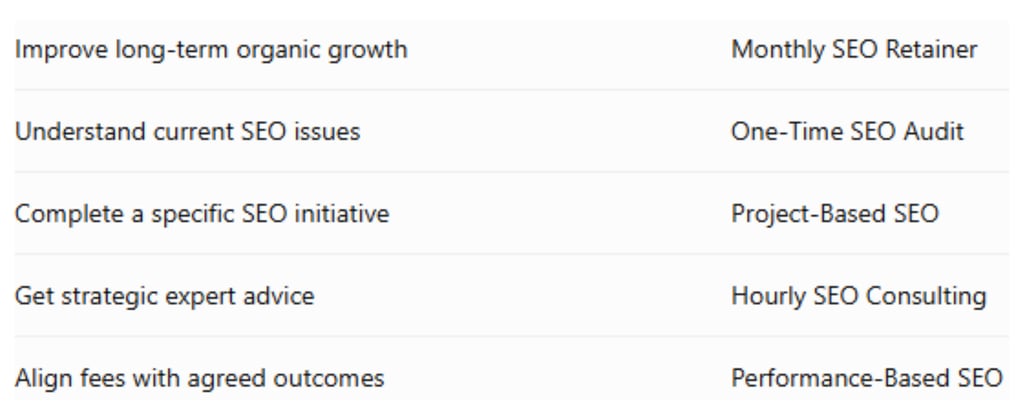
Depending on your goals, website maturity, and internal marketing capabilities, an SEO agency may recommend a one-time audit, a project-based engagement, hourly consulting, or an ongoing monthly partnership.
Understanding how each pricing model works will help you choose the right investment—and avoid paying for services you don't actually need.
Monthly SEO Retainers
A monthly retainer is the most common pricing model used by SEO agencies because search optimization is an ongoing process rather than a one-time task.
Search engines constantly evolve. Competitors publish new content, websites change, algorithms are updated, and user search behaviour shifts over time. Maintaining and improving rankings requires continuous optimisation, monitoring, and strategic adjustments.
A typical monthly SEO retainer may include:
Technical SEO audits and ongoing fixes
Keyword research and opportunity analysis
Content planning and optimisation
New content creation
On-page SEO improvements
Internal linking strategies
Link building and digital PR
Performance monitoring and reporting
Competitor analysis
AI Search Optimisation strategies
Monthly retainers are best suited for businesses looking to build long-term organic visibility and generate sustainable growth rather than short-term ranking improvements.
Best for:
Small and medium-sized businesses
Growing eCommerce stores
SaaS companies
National brands
Businesses committed to long-term SEO
One-Time SEO Audits
Not every website requires ongoing SEO immediately.
Sometimes, businesses simply need a comprehensive assessment of their current website to identify technical issues, content gaps, and opportunities for improvement.
A professional SEO audit typically reviews:
Website architecture
Crawlability and indexation
Page speed and Core Web Vitals
On-page optimisation
Content quality
Internal linking
Structured data
Backlink profile
Competitor benchmarking
The outcome is usually a detailed roadmap that prioritises the issues likely to have the greatest impact on organic performance.
One-time audits are particularly valuable before redesigning a website, migrating to a new platform, or investing in a long-term SEO campaign.
Best for:
Businesses evaluating their current SEO performance
Website redesigns
Pre-migration planning
Internal marketing teams needing expert guidance
Project-Based SEO
Some SEO initiatives have a clearly defined beginning and end.
Instead of paying a monthly retainer, businesses can hire an agency to deliver a specific project.
Examples include:
Website migrations
Technical SEO implementation
Large-scale content optimisation
New website launches
Ecommerce category optimisation
Programmatic SEO development
International SEO implementation
Local SEO rollouts
Schema markup implementation
Project pricing is determined by the complexity, scope, and estimated hours required rather than an ongoing monthly commitment.
Once the project is complete, businesses may either continue with a retainer or manage the ongoing optimisation internally.
Best for:
Website migrations
Platform upgrades
New product launches
Businesses with experienced in-house marketing teams
Hourly SEO Consulting
Some organisations already have developers, content writers, and marketing teams but occasionally require specialist SEO expertise.
In these cases, hourly consulting offers access to experienced professionals without committing to an ongoing agency relationship.
Consultants may assist with:
Technical troubleshooting
SEO strategy development
Content reviews
Website architecture planning
Recovery from algorithm updates
Enterprise SEO guidance
Team training
Executive workshops
Hourly consulting provides flexibility while allowing businesses to access senior-level expertise when required.
Best for:
In-house marketing teams
Agencies requiring specialist support
Large organisations
Businesses solving specific SEO challenges
Performance-Based SEO
Some agencies offer performance-based pricing, where fees are linked to rankings, traffic growth, or lead generation.
While this model may sound attractive, businesses should approach it carefully.
SEO performance depends on many variables outside an agency's direct control, including competition, search algorithm changes, website quality, historical authority, and business resources.
In some cases, performance-based contracts can encourage agencies to focus on low-competition keywords that are easier to rank rather than terms that drive meaningful business outcomes.
If considering this model, ensure that performance metrics are clearly defined, measurable, and aligned with your commercial objectives—not just search rankings.
Best for:
Businesses with clearly defined KPIs
Long-term partnerships built on transparency
Organisations comfortable with shared performance metrics
Which SEO Pricing Model Is Best?
There isn't a single pricing model that's right for every business. The best choice depends on your goals, internal capabilities, and stage of growth.
Rather than asking, "Which pricing model is the cheapest?", businesses should ask, "Which model gives us the best opportunity to achieve our growth objectives?"
The most successful SEO partnerships are built on clear goals, realistic expectations, and a pricing structure that matches the work required—not simply the lowest monthly cost.
Related Reading
If you enjoyed this article, you may also like:
Why "Trust", is the New SEO in 2026
How a Digital Marketing Agency Can Help with Local Business Advertising
WHY US
Comprehensive solutions for your marketing needs.
Contact Us
Subscribe Now to Receive Exclusive Marketing Tips and Updates!
Hello@1stopshop4marketing.com
0091 9867000502
© 2026. All rights reserved.