Why "Trust", is the New SEO in 2026
Discover how "trust-based blogging strategies", are reshaping "SEO in 2026". This article reveals why authentic experience and audience trust are now essential for digital success
SEO
Gagan Gujral
7/3/20264 min read
"The businesses that win in the AI era won't be the ones producing the most content. They'll be the ones earning the most trust."
Blogging Isn't Dead—It's Finally Growing Up
Every few years, someone declares blogging dead.
First, social media was supposed to replace blogs.
Then video marketing became the future.
After that, podcasts promised to take over.
Now, artificial intelligence has become the latest reason many believe blogging has lost its relevance. With tools capable of generating thousands of words in seconds, it seems logical to assume that written content has become a commodity.
But that assumption misses what is actually happening.
Artificial intelligence hasn't made blogging obsolete. It has exposed the difference between content created to satisfy algorithms and content created to earn trust.
For nearly two decades, businesses approached blogging as a search engine optimization exercise. Success was measured by the number of articles published, keyword rankings, backlinks, and page views. Marketing teams built content calendars around search volume rather than customer problems. The objective was simple: publish frequently, rank highly, and attract traffic.
That model worked—until everyone could do it.
Today, AI can generate a reasonably optimized article in less than a minute. It can summarize research, suggest headlines, improve grammar, and produce endless variations of existing ideas. The cost of creating content has collapsed.
When something becomes abundant, it loses its competitive advantage.
Content is no longer scarce.
Attention is.
Trust is.
Original experience is.
This shift marks one of the most significant turning points in the history of digital marketing.
Search engines have evolved beyond counting keywords. Readers have become more selective. AI-powered search assistants answer many questions before users ever click a website. Privacy regulations have reduced the effectiveness of third-party data. Businesses are increasingly relying on first-party relationships through newsletters, communities, and direct engagement.
In this new environment, blogging serves a very different purpose.
A blog is no longer simply a traffic acquisition tool.
It is a trust-building platform.
It demonstrates expertise before a sales conversation begins. It showcases real-world experience through case studies, original research, and informed opinions. It gives search engines, AI assistants, and potential customers evidence that a brand understands its subject better than competitors.
The most successful businesses are no longer asking:
"How many blogs should we publish this month?"
Instead, they ask: "How can we create something so valuable that people remember us, subscribe to us, cite us, and return for more?"
That is the fundamental difference between the old era of blogging and the one emerging in 2026.
This article explores why blogging is evolving from an SEO tactic into a strategic business asset. We'll examine the technologies driving this transformation, the growing importance of trust and first-hand expertise, the role of AI in modern content creation, and the practical frameworks businesses can adopt to remain visible in both traditional search engines and AI-powered discovery platforms.
For marketers, entrepreneurs, business owners, and content creators, the message is clear:
The future doesn't belong to those who publish the most.
It belongs to those who become the most trusted source of knowledge in their industry.
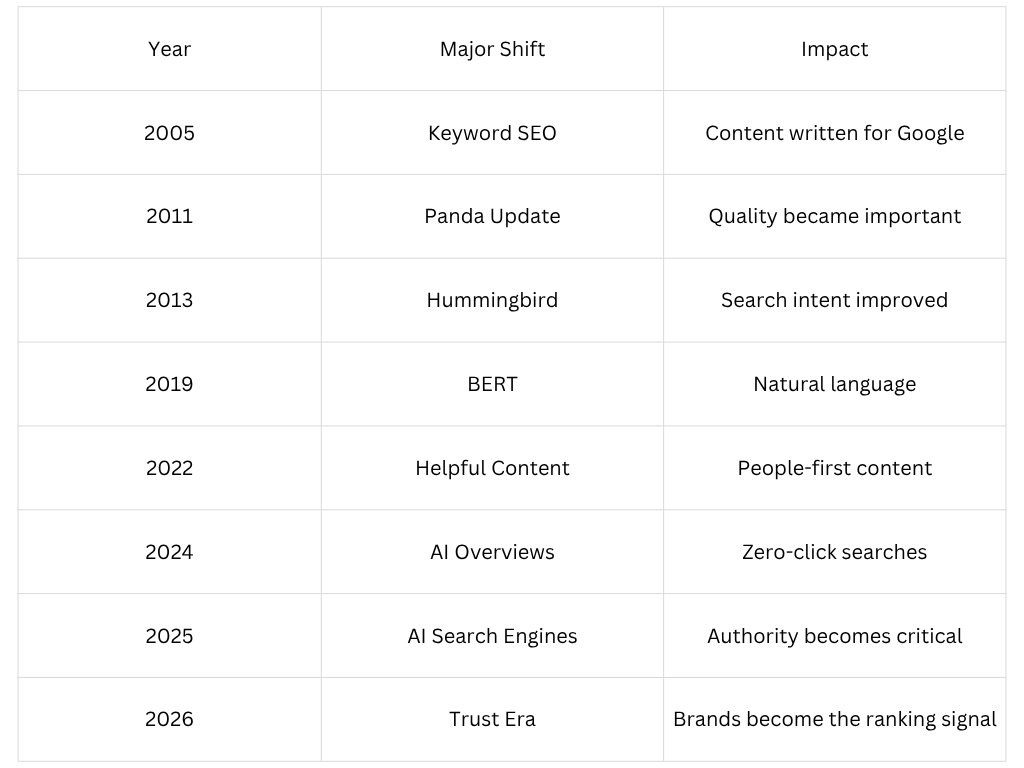
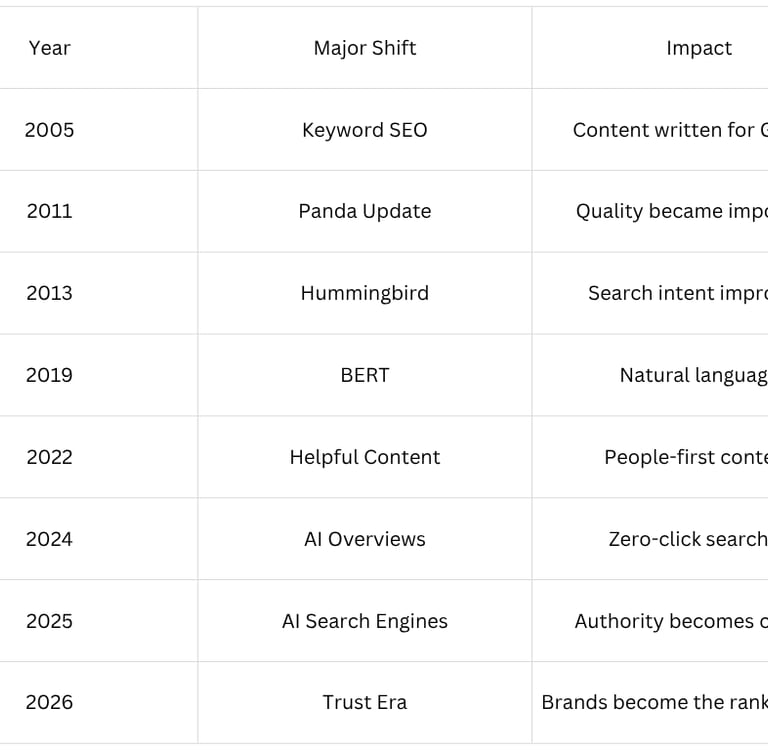
The evolution in SEO over time.
The Great Reset: How Blogging Reached a Turning Point
To understand where blogging is headed, we first need to understand how dramatically the content landscape has changed.
Between 2020 and 2026, digital marketing experienced a convergence of several disruptive forces that fundamentally altered how information is created, discovered, and consumed.
The first was the rapid advancement of artificial intelligence.
What began as AI-assisted copywriting evolved into sophisticated language models capable of producing complete articles, emails, product descriptions, and marketing campaigns in seconds. According to recent industry research, AI adoption in content marketing increased from approximately 83% of marketing teams in 2024 to nearly 97% in 2026. Almost every organisation now uses AI somewhere in its content workflow.
The second force was the rise of AI-powered search experiences.
Search is no longer limited to typing keywords into a search engine. Users increasingly ask conversational questions through AI assistants and receive immediate answers without visiting multiple websites. AI Overviews, answer engines, and conversational search interfaces have accelerated the growth of zero-click searches, where many queries end without a website visit.
For businesses, this represents a profound shift.
Visibility alone is no longer enough.
Brands must create content that is trustworthy enough to be referenced by both people and AI systems.
The third force is the explosion of content volume.
Because AI dramatically reduced the time and cost required to produce articles, the internet became flooded with similar, repetitive content. Thousands of websites now publish nearly identical advice, making it increasingly difficult for readers—and search engines—to distinguish genuine expertise from recycled information.
This abundance has changed what audiences value.
Readers are no longer impressed by another list of generic tips.
They are looking for unique perspectives, first-hand experiences, proprietary research, practical case studies, and authentic human insight.
In other words, they are looking for reasons to trust the person behind the content.
That single shift explains why blogging remains one of the most valuable marketing assets a business can own.
The blog itself is no longer the destination.
It is the foundation upon which authority, relationships, and long-term brand equity are built.
Bibliography (APA Style)
Edelman, & LinkedIn. (Latest ed.). B2B Thought Leadership Impact Report.
Fishkin, R. (2026, June 8). In 2026, Less than One Third of Google Searches Still Send a Click. SparkToro.
Litmus. (Latest ed.). State of Email.
Data & Marketing Association (DMA). (Latest ed.). Email Marketing Benchmark Reports.
Siege Media. (2026, February 5). The 7 Content Marketing Trends Shaping 2026.
Related Reading
If you enjoyed this article, you may also like:
How Much Does an SEO Agency Cost in 2026?
SEO in 2026 | Practical Strategies
WHY US
Comprehensive solutions for your marketing needs.
Contact Us
Subscribe Now to Receive Exclusive Marketing Tips and Updates!
Hello@1stopshop4marketing.com
0091 9867000502
© 2026. All rights reserved.