Schema Markup for Local Businesses: A Beginner's Guide
Discover what schema markup is, why it matters for local SEO, and how local businesses can use it to appear in richer, more visible search results..
SEO
7/12/20264 min read
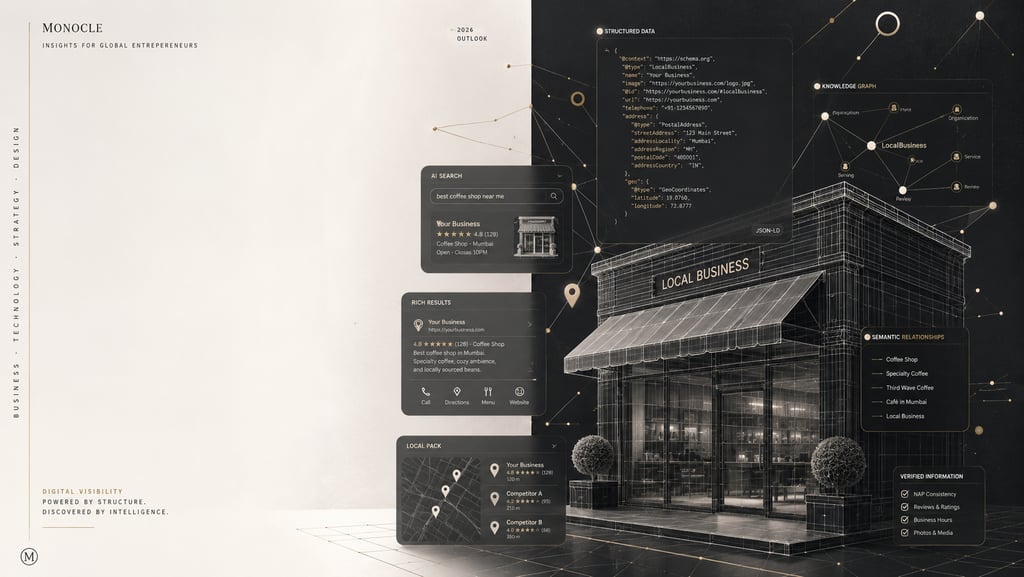
If you've ever searched for a "plumber near me" or "best bakery in Mumbai" and noticed a business showing up with star ratings, opening hours, or a map right in the search results, that's schema markup at work. It's one of the most underused local SEO tools—and one of the easiest to get right once you understand the basics.
This guide breaks down what schema markup is, why it matters for local businesses, and how to start using it without needing to be a developer.
What Is Schema Markup?
Schema markup is a type of code—technically called structured data—that you add to your website to help search engines understand exactly what your content means, not just what it says.
Without schema, Google can read your webpage and guess that you're a business, that you have a phone number, and that you operate in a certain area. With schema, you're telling Google directly: this is a business name, this is the address, these are the hours, this is the review rating. There's no guessing involved.
Schema markup follows a shared vocabulary maintained by Schema.org, a project backed by Google, Microsoft, Yahoo, and Yandex. It's written in a structured format—most commonly JSON-LD—and placed in the code of your website. Visitors never see it, but search engines do.
Why Schema Markup Matters for Local SEO
For local businesses specifically, schema markup does a few important jobs at once.
It helps you earn rich results. Star ratings, price ranges, business hours, and FAQ dropdowns in search results all come from structured data. These rich results take up more space, catch more attention, and typically earn higher click-through rates than a plain blue link.
It strengthens local search signals. Search engines rely heavily on consistent, structured business information to decide who shows up for "near me" searches. Schema reinforces the same details found in your Google Business Profile and citations, which builds trust in your listing.
It supports AI-powered search. AI assistants and AI Overviews pull information from structured, verifiable data to answer questions like "best dentist near me" or "affordable architect nearby." A business with clear schema markup is easier for these systems to understand, trust, and recommend.
It reduces ambiguity. If your business name is similar to others, or your website has multiple locations or services, schema helps search engines correctly match search intent to the right page.
Types of Schema Markup Local Businesses Should Know
You don't need every schema type available—just the ones relevant to how customers find and evaluate your business.
Local Business Schema
This is the foundation. It tells search engines your business name, address, phone number, hours, price range, and category. If you operate in a specific niche, there are more specific versions too, such as Restaurant, Dentist, Legal Service, or Home And Construction Business.
Review and Aggregate Rating Schema
This markup surfaces star ratings directly in search results. It pulls together the number of reviews and average rating so potential customers see social proof before they even click.
FAQ Page Schema
If your website has a frequently asked questions section, this markup can turn those questions into expandable results directly in Google, giving you more visibility without extra ad spend.
Breadcrumb List Schema
This shows the page hierarchy in search results (for example, Home > Services > Local SEO), making your listing easier to scan and helping search engines understand your site structure.
Product and Offer Schema
For local retailers, this highlights pricing, availability, and product details directly in search results.
Event Schema
Useful for businesses hosting workshops, sales, classes, or in-store events, allowing dates and details to appear directly in search.
How to Add Schema Markup to Your Website
You don't need to write code from scratch to get started.
Identify the right schema type for your business and page (start with LocalBusiness on your homepage).
Use a generator tool to build the JSON-LD code, filling in fields like business name, address, phone number, and hours.
Add the code to your page, typically in the page header, or through a plugin if your site runs on a platform like WordPress or Shopify.
Test it using Google's Rich Results Test to confirm search engines can read it correctly.
Keep it updated. If your hours, address, or services change, your schema needs to match—inconsistent information can undermine trust signals rather than build them.
Common Mistakes to Avoid
Marking up information that isn't visible on the page. Schema should reflect what's actually shown to visitors, not information hidden solely for search engines.
Inconsistent NAP (Name, Address, Phone) details between your schema, website, and Google Business Profile. Mismatches confuse search engines and can hurt local rankings.
Overloading a page with irrelevant schema types just because they exist. Relevance matters more than volume.
Forgetting to test or validate the markup, which can result in errors that prevent rich results from appearing at all.
Schema Markup Is a Long-Term SEO Investment
Schema markup won't produce results overnight, and it isn't a replacement for strong local SEO fundamentals like Google Business Profile optimization, consistent citations, and quality content. But it's a foundational layer that makes everything else work harder—helping search engines and AI systems trust, understand, and showcase your business more prominently.
For local businesses competing for visibility in crowded search results, structured data is no longer optional. It's one of the clearest ways to stand out, earn trust at a glance, and turn searchers into customers.
Not sure where to start with schema markup or local SEO for your business? 1stopshop4marketing helps local businesses build the technical foundation—schema, citations, Google Business Profile, and beyond—needed to compete and win in local search.
Related Reading
If you enjoyed this article, you may also like:
How Much Does an SEO Agency Cost in 2026?
WHY US
Comprehensive solutions for your marketing needs.
Contact Us
Subscribe Now to Receive Exclusive Marketing Tips and Updates!
Hello@1stopshop4marketing.com
0091 9867000502
© 2026. All rights reserved.